
TWO TOURS TO NEW CONNECTICUT
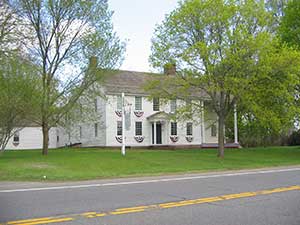
Henry Leavitt Ellsworth grew up in this home in Windsor, Connecticut. Today it is a museum owned by the Connecticut Daughters of the American Revolution. Image: Wikimedia Commons.
Every year, from 1800 on, there were scores of adventurous teenagers on the road, heading west. Young men and even a few young women eager to see the Ohio country, but without the means to go, signed on as drivers or helpers with kin or neighbors. Investors' sons often made the "tour" on horseback to see the family's land.
On May 29, 1811, nineteen year old Henry Leavitt Ellsworth, one of twin sons born to Chief Justice Oliver and Abigail (Wolcott) Ellsworth left the comforts of Elmwood, the family home at Windsor, Connecticut, to join his brother-in-law Ezekiel Williams on A Tour to New Connecticut. Just months before, Ellsworth's friend Margaret Van Horn Dwight, (the orphaned granddaughter of Jonathan Edwards and niece of Yale President Timothy Dwight) had travelled from New Haven to stay with cousins in Warren, Ohio.
For both young people, it was a profound coming of age adventure. Although the northern route (which Ellsworth took on his return) would have taken them through towns already settled by Yankee friends and relatives, the Forbes Road through Pennsylvania seemed to have been designed for culture shock. This was a time when regional differences were more pronounced than they would ever be again, and both travellers were alternately amazed, amused and put off by the foreign languages, alien food, strange architecture, and odd customs they encountered. They, in turn, were subjects of curiosity. In the space of only a few weeks, their endurance was tested, and their minds were opened.
A Tour to New Connecticut in 1811: The Narrative of Henry Leavitt Ellsworth has been edited by Phillip R. Shriver and published by the Western Reserve Historical Society. The Yale University Press edition of Margaret Van Horn Dwight's journal, A Journey to Ohio in 1810, from which we have quoted below, can still be found in many libraries. A newer version is available from University of Nebraska Press.
Here are a few excerpts:
Dwight:
Milford, Friday Eve. at Capt Pond's.
Shall I commence my journal, my dear Elizabeth, with a description of the pain I felt at taking leave of all my friends, or shall I leave you to imagine?... We had a cold unsociable ride today, each one of us occupied in thinking of the friends we had left behind & of the distance, which was every moment increasing, between them & us....We stopt to eat oats at a Tavern in Fairfield...an old Lady came into the room where Miss W and we were sitting...."Well! Gals where are you going?" "To New Connecticut" "You bant tho - To New Connecticut? Why what a long journey! do you ever expect to get there? How far is it?" "Near 600 miles" "Well Gals, you Gals & your husbands with you?" "No Ma'am" "Not got your husbands! Well I don't know - they say there's wild Indians there!"
Ellsworth:
Hartford, May 30th, 1811. I left Windsor on the 29th and arrived at Hartford about sunset, where I found my travelling companion (Mr. Williams) in good health and prepared for the journey...At this place I intended to have provided some Instruments of Death, but could find nothing that would answer our purpose better than some large pistols, the luggage of which, I thought would more than counterballance the danger to which we should be exposed from the depradation of Robbers. "Fate steals along with silent tread, Found oftenest in what least we dread."
In the early part of the journey, both Ellsworth and Dwight were surrounded by the still familiar white clapboard houses, weathered grey barns, and hilly New England roads and fields they had known since childhood. But as they reached the more recently settled towns of Western Connecticut, architectural styles began to change. In Plymouth, Ellsworth notes
The new fashion of building is predominant here viz. of building with ends to the street, but here and there you may discern an old mansion with a good broad side to the public...
Miss Dwight, travelling parsimoniously with a deacon's family, was mortified to be seen riding through Connecticut in a common "waggon" and did not poke her head out until well out of range.
The country we pass thro' till we are beyond N. York, I need not describe to you, nor indeed could I; for I am attended by a very unpleasant tho' not uncommon, companion - one to whom I have bow'd in subjection ever since I left you - Pride - It has entirely prevented my seeing the country lest I should be known - You will cry "for shame" & so did I but it did no good - I could neither shame nor reason it away, & so I suppose it will attend me to the mountains, then I am sure it will bid me adieu -" for you know the proverb " pride dwelleth not among the mountains-
In fact, the mountains were daunting.
Ellsworth:
To our surprize we beheld the Allegany mountains this morning 12 miles distant. Their appearance is rather discouraging to intrepid souls. However we shall attempt undismayed to climb their craggy cliffs. We rode to Strasburgh to breakfast, a village situated at the foot of the mountains. This village contains but few houses and those chiefly taverns. We are now at the very foot of the mountains thinking what an Herculean job it will be to get over them.
4 o'clock P.M. Though our distance has not been great we feel quite fatigued with ourday's ride or rather with our footing for we walked down all the descents. We have passed the first mountain consisting of three ridges 1 1/2 mile high each...This is known by the name of the 3 Sisters or 3 brothers. The Mountains are barren except a few trees which spring out from the crevices of rocks. The valleys are much richer and some of them highly cultivated. In these confined valleys are small villages - with schools...
We get more muddy detail from Dwight, who crossed in a wagon and often walked up as well as down. Initially, she was in good health and game for the climb.
Jennyauter-P-Wednesday 2 oclock PM - between 2 brothers - This morning we cross'd the first mountain call'd first brother & are in an inn between the first & second brother; the latter we are soon to ascend -- The first m-n is 3 1-2 miles over,-better road than we expected - but bad enough to tire the horses almost to death - We met & were overtaken by a number of people--We all walk'd the whole distance over - I did not stop at all to rest till I reach'd the top - I was then oblig'd to wait for some of them to overtake me, as I had outwalk'd them all...
There were notable small moments along the way.
When we had nearly reach'd the foot of the mountain, we heard some music in the valley below, & not one of us could imagine from what it proceeded; but soon found it was from the bells of a waggoner - He had twelve bells on the collars of his horses, (not sleigh bells) & they made a great variety of sounds which were really musical at a distance-
But a bit further on -
I do not feel to night, my dear Elizabeth, as if I should ever see you again - 3 mountains & more hundreds of miles part us;...I cannot think of traversing this road again - If I live to return I will wait till the new turnpike is finished-- We cross'd the last brother this morning. We stopt at noon, at a dismal looking log hut tavern- The landlady talk'd about bigotry, bigotted notions, liberty of conscience - She did not look as if she knew the meaning of conscience, much less of bigotry - All this afternoon we have been walking over young mountains, distant relations of the 3 brothers, but not half as clever - I was so lame & so tir'd that for an hour I did not know but I must set down & die --
But Allegany mountain offered a view worthy of the climb.
At the highest part of it is a most beautiful prospect of mountains - 5 or 6 ridges one after the other - We clamber'd up a high rock near to the highest part, - I wish I could describe it to you - We found winter green berrys in abundance on it -- I pick'd a sprig of ivy from the top, which I will send you - call it laurel & preserve it, as it came from the very backbone of America, as they all tell us-
That evening she encountered "a curiosity" --A young lady who had come from New Connecticut unmarried - after staying in Warren a year. The next day a cold front moved into the mountains and the road, filled with large stones and deep mud holes, nearly stopped their forward motion - which was now entirely on foot since the horses can "scarcely stir the waggon". She had plenty of company in her misery.
From what I have seen and heard, I think the State of Ohio will be well fill'd before winter, - Waggons without number, every day go on - One went on containing forty people - We almost every day see them with 18 or 20.
Ellsworth encountered the same heavy traffic on the Forbes Road the following spring. In addition to professional Conestoga waggoners moving merchandise, he noted 270 sheep and 100 cattle driving to market, a regiment of U.S. troops en route to Pittsburgh, and many ordinary families.
Though the passage over the mountain thus far would by us Conn. folks receive the appelation of most terrible, it is nevertheless frequently made. In the short distance of 9 miles and in the space of 3 hours we met 17 waggons drawn by 102 horses, that is, 6 in a team; besides we passed 7 or 8 waggons in the same time and distance.
Both Ellsworth and Dwight made the trip safely and the two old friends met for an afternoon in New Connecticut. Within a year of being introduced to frontier society, Margaret Van Horn Dwight was married to Mr. William Bell, a well to do Irish merchant in Warren. The couple soon moved to Pittsburgh, where their home was "a center of hospitality." Margaret bore 13 children before she died in her early forties. One of her great grandchildren was Winston Churchill.
Henry Leavitt Ellsworth stayed in Ohio just long enough to visit all of the family's widespread properties, and then returned to Connecticut via the Lake Shore route through New York State, taking in the waters at Ballston Spa. Some years later he accompanied Washington Irving on a tour of the prairie. He became a Mayor of Hartford, a Commissioner to the Indian tribes in Oklahoma, the first U.S. Commissioner of Patents, and the "father" of the Department of Agriculture. He died in Indiana, leaving a considerable bequest to Yale Divinity School.